Weaving Elegance: Unraveling the Legacy of Maheshwari Sarees and the Historical Town of Maheshwar
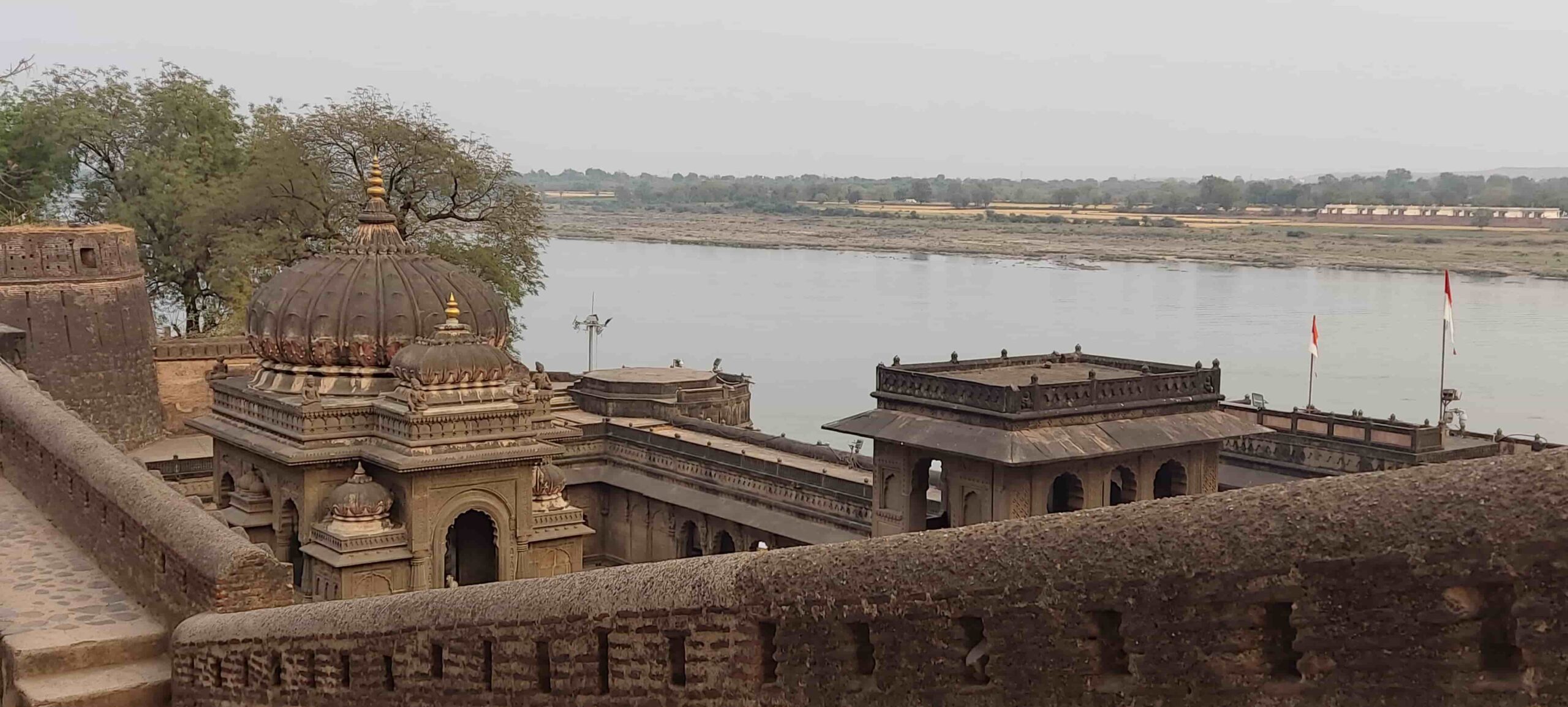
Maheshwar is a town situated on the banks of river Narmada in the state of Madhya Pradesh, India. It has a significance in the history of that region. During ancient times it was also known by the name Mahismati. The existence of this place can be traced back even to the times of Ramayan since there is a mention that it was the capital city of King Sahasrarjun who once defeated Raavan. However, King Sahasrarjun was later on killed by his son Parshuram, as a result of his being disrespectful and abusive towards Rishi Jamadagni.
Maheshwar also became the capital city of Queen Ahilyabai Holkar, a remarkable ruler who made lasting contributions to the region.
Maheshwar Under Queen Ahilyabai Holkar:
Queen Ahilyabai Holkar, who reigned from 1767 to 1795 governed her kingdom from the magnificent fort located on the bank of river Narmada. She was the daughter-in-law of Maharaja Malhar Rao Holkar, the founder of the dynasty of the Holkar Maharajas of Indore. She was given the responsibility of the Malwa kingdom by her father in law, after she lost her husband Khanderao Holkar in a battle of Kumbher in 1754. She was later on crowned as the Queen of Holkar dynasty a year after the death of her father in law. Eventually she persuaded the Peshwas to confirm her as the overseer of the Holkar domains. Thus, ensuring peace and prosperity within her realm/territory amidst, the turbulence prevailing across India during that period.
Restoration of Temples and Places of Worship:
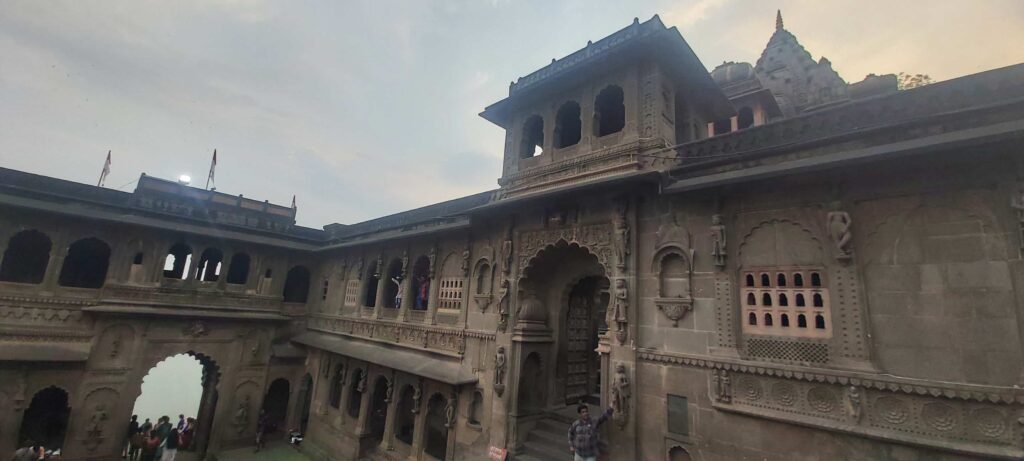
Queen Ahilyabai Holkar was also a major proponent for the restoration of temples and places of worship of the Hindu faith, destructed and destroyed by the great Iconoclast Aurangzeb. She took the responsibility upon herself, to repair, resurrect and rebuilding of the temples and Dharmashalas ( resting places for pilgrims), even beyond her territories. The most prominent among her efforts, being the rebuilding of the famous Kashi Vishwanath Temple. She played a crucial role in preserving the rich cultural and religious heritage of the Hindu faith.
The Maheshwari Weaving Tradition:
Queen Ahilyabai Holkar’s contributions were not limited only to the governance and restoration of the religious sites. The credit of introducing and popularising the world famous Maheshwari saree goes to Queen Ahilyabai Holkar or Maa Saheb as she was fondly referred to by her subjects, a legacy that is still thriving. She invited and patronised the skilled weavers from Gujarat, Karnataka, and Malwa (present-day Indore) to revive the tradition of weaving and to provide employment to her people. The legend is that she designed the first-ever Maheshwari saree woven.
Maheshwari Sarees: Timeless Elegance:
Traditionally, Maheshwari sarees were woven in silk. Within a short period it gained popularity across India because of its exquisite and elegant designs. Maheshwari sarees are relatively light weight elegant and sophisticated Handloom sarees. Later on, with the passage of time cotton was introduced as a yarn along with silk, resulting in highly sophisticated glossy sarees. Today, Maheshwari sarees are available in pure mulberry silk and in cotton silk. In some sarees pure tussar silk is also used in warp.
In pure silk Maheshwari sarees, both the warp and weft yarns are made of mulberry silk. In cotton silk variation, the warp yarn is degummed mulberry silk or tussar silk, whereas the weft is high-quality mercerized cotton. Zari (metallic thread) is also used both in pure silk and in cotton silk variations as warp as well as weft, to add sophisticated shimmer to the sarees and making them more vibrant. The border is mainly made of Zari and silk thread. The designs on the border and pallu are derived from carvings in the Forts of Madhya Pradesh.
Distinctive Feature of Maheshwari weaving
The uniqueness of Maheshwari weaving is that the design is decided on the warp itself while tying it, which are mostly checks or stripes of various dimensions. The weft is generally a plain weave, except for the butis (small motifs) in some cases. Maheshwari sarees fall under five broad categories namely, Chandrakala, Baingani Chandrakala, Beli, Chandratara, and Parbi. Chandrakala and Baingani Chandrakala are plain weaves, while Chandratara, Beli, and Parbi are weaves with stripes or checks with or without butis.
Geographical Indication Tag:
The art of Maheshwari weaving has gained recognition and protection from the Government of India. In 2010, Maheshwari weave was registered with a Geographical Indication (GI) Tag under the Geographical Indication of Goods (Registration and Protection) Act, 1999. It received the GI number 197 from the Chennai Office, signifying its cultural and historical significance.